Post by : Bianca Qureshi
The solar system is an intricate cosmic neighborhood comprising eight major planets, each with unique characteristics, compositions, and orbital patterns. Studying all planets not only enhances our knowledge of space but also provides insights into the formation and evolution of our solar system. This article delves into detailed facts, unique features, and scientific theories about all planets.
Distance from Sun: 57.9 million km
Diameter: 4,879 km
Orbital Period: 88 days
Key Facts:
Mercury is the closest planet to the Sun and the fastest-moving planet in our solar system.
It has almost no atmosphere, causing extreme day-night temperature differences (-173°C to 427°C).
Its surface is heavily cratered, similar to the Moon, with features like Caloris Basin.
Mercury’s magnetic field is surprisingly strong despite its small size.
It completes a rotation on its axis every 59 Earth days, creating a unique day-night cycle.
Distance from Sun: 108.2 million km
Diameter: 12,104 km
Orbital Period: 225 days
Key Facts:
Venus is often called Earth’s twin due to its similar size and mass.
Its dense atmosphere, mostly carbon dioxide, traps heat through a runaway greenhouse effect, reaching 465°C.
Venus rotates slowly and in a retrograde motion; its day is longer than its year.
Sulfuric acid clouds cover the planet, making its atmosphere toxic and reflective.
No moons or rings exist around Venus, unlike most other planets.
Distance from Sun: 149.6 million km
Diameter: 12,742 km
Orbital Period: 365.25 days
Key Facts:
Earth is the only known planet supporting life due to its ideal atmosphere and liquid water.
71% of the Earth’s surface is covered with water, creating oceans, rivers, and lakes.
The atmosphere protects life from harmful solar radiation.
Earth’s magnetic field helps shield the planet from solar winds.
Its single moon stabilizes Earth’s rotation and influences tides, crucial for ecosystems.
Distance from Sun: 227.9 million km
Diameter: 6,779 km
Orbital Period: 687 days
Key Facts:
Mars has a reddish hue due to iron oxide (rust) on its surface.
Olympus Mons, the tallest volcano, and Valles Marineris, a giant canyon, make it geologically interesting.
Evidence of ancient riverbeds suggests Mars may have had liquid water.
Mars has two small moons: Phobos and Deimos, likely captured asteroids.
Scientists consider Mars the prime candidate for future human colonization.
Distance from Sun: 778.3 million km
Diameter: 139,820 km
Orbital Period: 12 years
Key Facts:
Jupiter is the largest planet, with more than 90 moons including Ganymede, the largest moon in the solar system.
Its Great Red Spot is a giant storm persisting for over 300 years.
Jupiter has a strong magnetic field and faint rings.
Composed mainly of hydrogen and helium, it may have a rocky core.
It plays a protective role, attracting comets and asteroids with its gravity, reducing impact risks for inner planets.
Distance from Sun: 1.43 billion km
Diameter: 116,460 km
Orbital Period: 29 years
Key Facts:
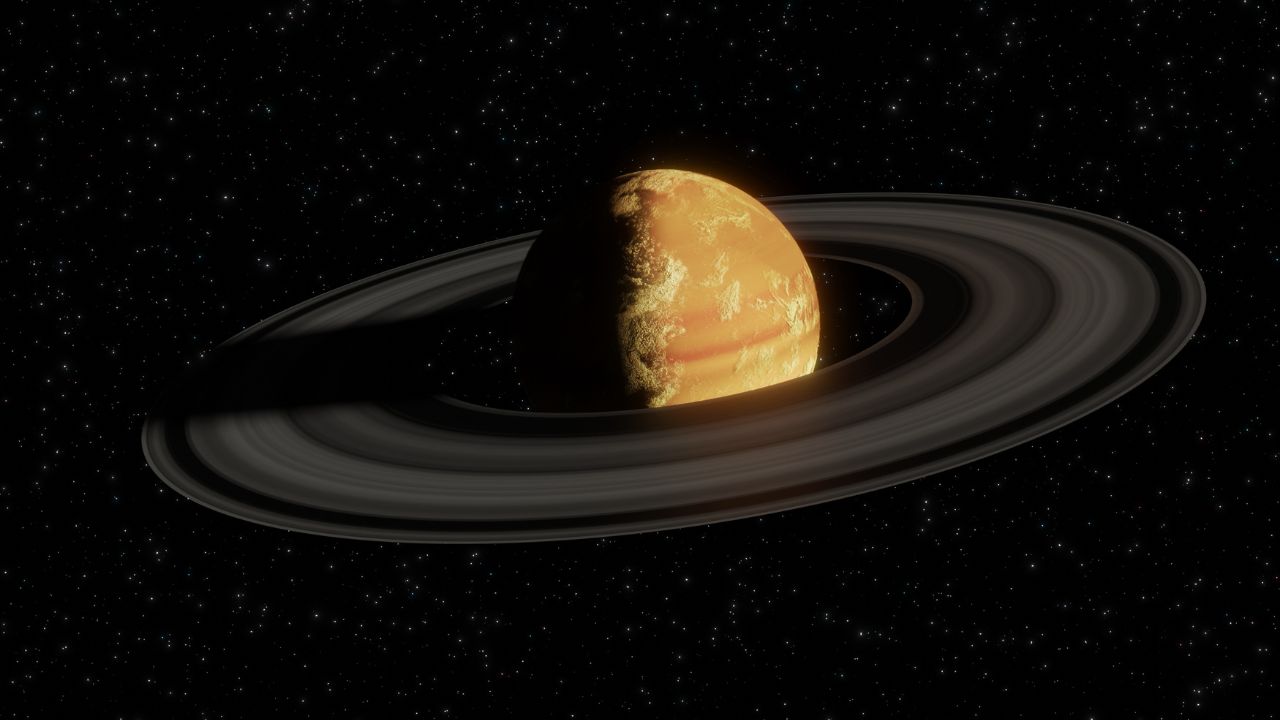
Saturn’s rings are made of ice, rock, and dust, and are divided into seven main groups.
Saturn has more than 80 moons, including Titan, which has a thick nitrogen-rich atmosphere.
It is the least dense planet; its density is lower than water.
Saturn’s winds reach up to 1,800 km/h.
Studying Saturn helps understand planetary ring formation and evolution.
Distance from Sun: 2.87 billion km
Diameter: 50,724 km
Orbital Period: 84 years
Key Facts:
Uranus rotates almost on its side, possibly due to a massive collision in the past.
Its pale blue color comes from methane gas in the atmosphere.
Uranus has 27 moons and faint rings, discovered in the 1970s.
Extremely cold, with average temperatures around -224°C, making it the coldest planet.
Uranus’ unusual tilt affects its seasons, causing each pole to experience 42 years of sunlight followed by darkness.
Distance from Sun: 4.5 billion km
Diameter: 49,244 km
Orbital Period: 165 years
Key Facts:
Neptune has the strongest winds in the solar system, exceeding 2,100 km/h.
It appears deep blue due to atmospheric methane absorption of red light.
Neptune has 14 known moons, with Triton being geologically active and having geysers.
Its orbit is the farthest from the Sun, with extreme cold around -214°C.
Discovered in 1846 through mathematical predictions before being observed directly.
Inner planets (Mercury, Venus, Earth, Mars) are rocky with thin atmospheres.
Outer planets (Jupiter, Saturn, Uranus, Neptune) are gas or ice giants, mostly hydrogen, helium, and ices.
Planets closer to the Sun have shorter orbital periods, while distant planets take decades to orbit once.
Gravitational interactions between planets influence asteroid belts and comet paths.
Planetary Formation Theory: All planets formed from a protoplanetary disk around the Sun 4.6 billion years ago.
Planet Migration Theory: Some planets, especially gas giants, may have shifted positions after formation.
Exoplanet Comparison: Observing exoplanets helps understand how unique or common our solar system is.
All planets in the solar system present a fascinating study of diversity, from Mercury’s scorching surface to Neptune’s icy winds. By exploring all planets, we gain insight into the forces shaping our solar system, planetary evolution, and the potential for life beyond Earth. Understanding each planet’s characteristics, atmosphere, and unique features enriches both scientific knowledge and human curiosity.
Disclaimer:
The content provided in this article is for informational and educational purposes only. While DXB News Network strives to ensure the accuracy and reliability of the information about all planets and related scientific facts, the network does not guarantee the completeness, timeliness, or accuracy of the data. Readers are encouraged to verify information independently and consult authoritative sources for academic, professional, or research purposes. DXB News Network is not responsible for any decisions, actions, or interpretations made based on this content.
Family Wins “Family of the Year 2026” at Noor Al Quran Event in Ras Al Khaimah
A family honored at the Noor Al Quran initiative in Ras Al Khaimah for Quran memorization and strong

US Approves $16.5B Arms Deal Amid Iran War Escalation
US approves $16.5B arms sale to Gulf allies and $7B to UAE, boosting defence amid Iran tensions whil

UAE Busts Hezbollah-Iran Terror Network, Members Held
UAE authorities have broken a terror network linked to Hezbollah and Iran, arresting members accused

Swiatek Stunned by Linette in Miami Open Upset Shock
Iga Swiatek suffered a shocking defeat to Magda Linette at the Miami Open, marking her first opening

UAE Orphan Fund Raises AED 3.3 Billion in Ramadan Drive
UAE’s Mother of the Nation Orphan Fund raises AED 3.3B in Ramadan, boosting support for education, h

Ramadan in the UAE: Reflections on Humanity, Leadership, and Lasting Values
A heartfelt Ramadan reflection by Osama Regaah on UAE’s spirit of humility, unity, and leadership, a

Dhurandhar 2 Opens Big, Crosses ₹100 Cr on Day 1
Ranveer Singh starrer Dhurandhar 2 earns ₹102 Cr on day one despite delays, beating past Bollywood o


Bank of Baroda Faces Abu Dhabi Legal Battle over NMC Collapse
Bank of Baroda’s involvement in Abu Dhabi litigation tied to the NMC Healthcare collapse raises repu

Top Museum Openings of 2026 Set to Transform Global Tourism
From Los Angeles to Abu Dhabi and Brussels, 2026 brings major museum launches—Lucas Museum, Guggenhe

UAE Tour Highlights UAE’s Strength in Hosting Global Sports Events
Abu Dhabi Sports Council says the successful UAE Tour reflects the UAE’s leading role in hosting maj
EU Seeks Clarity from US After Supreme Court IEEPA Ruling
European Commission urges full transparency from the US on steps after Supreme Court ruling, emphasi
SpaceX Launches 53 New Satellites for Expanding Starlink Network
SpaceX launches 53 Starlink satellites in two Falcon 9 missions, breaking reuse records and expandin

RTA Awards Contract for Phase II of Hessa Street Upgrade in Dubai
Phase II of Hessa Street Development to add bridges, tunnel, and upgraded intersections, doubling ca

UAE Gold Prices Today, Monday 16 February 2026: Dubai & Abu Dhabi Updated Rates
Gold prices in UAE on 16 Feb 2026 updated: 24K around AED 599.75/gm, 22K AED 555.25/gm, and 18K AED

Over 25 Ahmedabad Schools Receive Bomb Threat Email, Authorities Investigate
More than 25 schools in Ahmedabad evacuated after bomb threat emails mentioning Khalistan. Authoriti