Post by : Bianca Qureshi
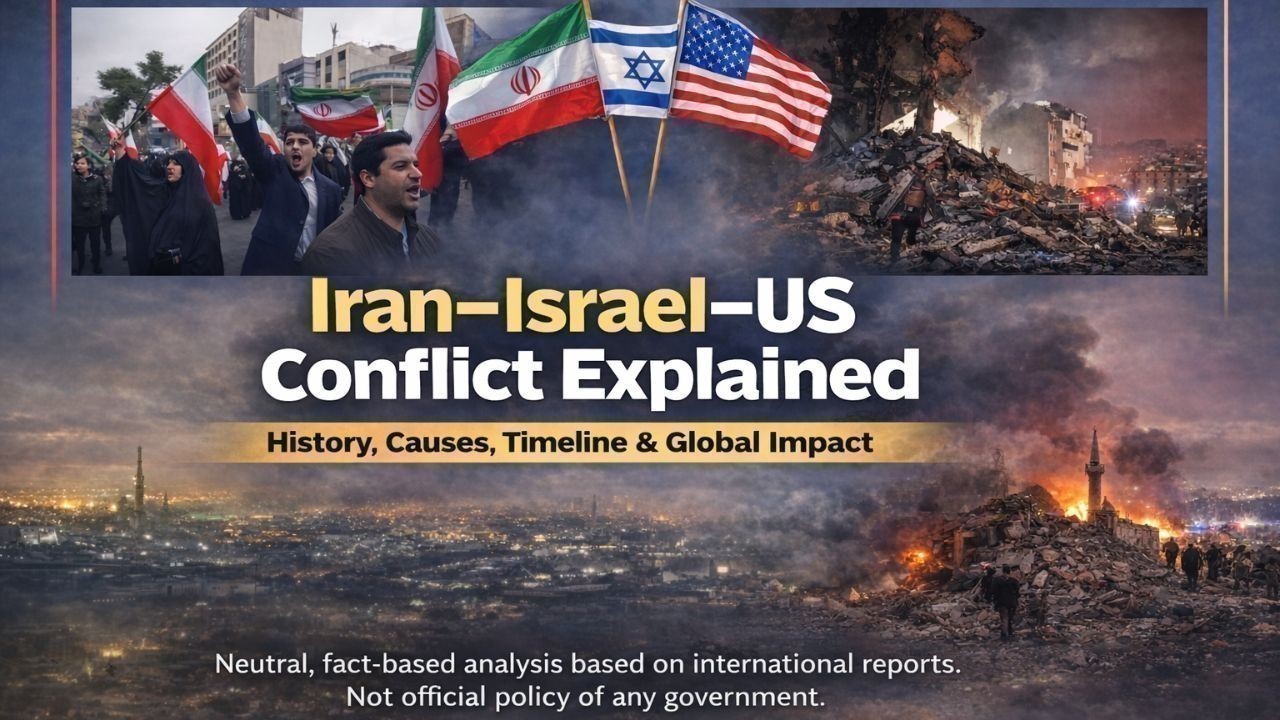
The escalating tensions involving Iran, Israel, and the United States are the result of decades of geopolitical rivalry, security concerns, nuclear disputes, and regional power competition.
Rather than a sudden war, the situation reflects a long-developing pattern of confrontation — sometimes direct, often indirect — across multiple Middle Eastern theatres including Gaza, Lebanon, Syria, Iraq, Yemen, and the Persian Gulf.
This report provides a neutral, fact-based overview of:
Historical background
Key political and security drivers
The role of proxy groups
The nuclear dispute
Recent escalation trends
Potential regional and global impact
Modern mistrust between Iran and the United States is often traced back to 1953, when Western intelligence agencies supported the removal of Iran’s then-Prime Minister, Mohammad Mossadegh. The Shah was subsequently restored to power.
Many historians consider this event a turning point in Iranian perceptions of Western involvement in domestic affairs.
In 1979, the Iranian Revolution led to the establishment of an Islamic Republic.
Shortly afterward:
The U.S. Embassy in Tehran was seized.
52 American diplomats were held for 444 days.
Diplomatic relations were severed.
Since then, relations between Tehran and Washington have remained strained, shaped by sanctions, regional security disputes, and ideological differences.
Before 1979, Iran and Israel maintained limited but pragmatic cooperation.
After the revolution:
Iran officially ended relations with Israel.
Tehran adopted a policy of strong support for the Palestinian cause.
Israeli officials increasingly described Iran’s regional posture and nuclear ambitions as security threats.
Over time, this evolved into what analysts describe as a long-running “shadow conflict,” with indirect confrontations across multiple regional arenas.
Iran’s nuclear program began in the 1950s under international cooperation initiatives.
Decades later, concerns grew among Western governments and Israel that Iran’s enrichment activities could potentially lead to weapons capability — a claim Iran has repeatedly denied, maintaining that its program is for civilian purposes.
In 2015, Iran signed the Joint Comprehensive Plan of Action (JCPOA) with major world powers, agreeing to limit enrichment activities in exchange for sanctions relief.
In 2018, the United States withdrew from the agreement and reimposed sanctions. Iran subsequently expanded certain nuclear activities beyond previous limits.
Israel has consistently stated it will prevent Iran from developing nuclear weapons capability, while Iran maintains its nuclear rights under international law.
Iran has supported what it describes as an “Axis of Resistance,” which includes armed groups operating in Lebanon, Gaza, Iraq, Syria, and Yemen.
These groups include:
Hezbollah
Hamas
Certain Iraqi militias
Houthis
Several countries designate these groups as terrorist organizations.
Israel and the United States view these groups as extensions of Iranian regional influence. Iran states that it supports regional resistance movements politically and, in some cases, materially.
This dynamic has resulted in years of indirect confrontation.
In October 2023, Hamas launched a large-scale attack inside Israel, triggering a major Israeli military response in Gaza.
The conflict significantly increased regional tensions. While Iran denied direct operational involvement in the attack, it has historically supported Palestinian armed groups.
Following the Gaza conflict:
Cross-border exchanges intensified in Lebanon.
Militia activity increased in Iraq and Syria.
Maritime tensions rose in parts of the Red Sea and Gulf region.
Observers noted a heightened risk of wider regional escalation.
In 2024, reports indicated direct exchanges between Israel and Iran following strikes on Iranian-linked targets in Syria.
For the first time, Iran launched a large-scale missile and drone operation toward Israeli territory. Most projectiles were reportedly intercepted with assistance from allied defense systems.
This marked a significant shift from indirect proxy engagement to more visible state-level confrontation.
Subsequent months saw additional strikes, counter-strikes, and increased military readiness across the region.
Each side frames its actions as defensive. However, actions by one are often perceived as escalation by the other.
Iran argues its nuclear program is peaceful.
Israel argues that even nuclear threshold capability poses a strategic risk.
Competition for influence in Iraq, Syria, Lebanon, and Yemen plays a major role in shaping confrontation.
The United States maintains strong security ties with Israel and Gulf partners.
Iran maintains partnerships with non-state actors and certain regional governments.
The Strait of Hormuz remains one of the most critical global oil transit routes.
Any disruption could:
Impact oil prices
Affect global supply chains
Increase shipping insurance costs
Create wider economic uncertainty
Regional governments, including Gulf states, closely monitor developments to prevent spillover instability.
Energy market volatility
Shipping and aviation route adjustments
Investor uncertainty
Emergency international consultations
Mediation efforts by global powers
Calls for de-escalation from multiple governments
Increased regional military deployments
Heightened air defense activity
While tensions remain high, analysts note that:
Major powers generally seek to avoid full-scale regional war.
Backchannel diplomacy continues.
Economic interdependence acts as a restraint.
However, miscalculation or large-scale casualties could change the trajectory.
Limited strikes and deterrence-based stability.
Potential revival of nuclear negotiations or broader regional talks.
If additional fronts open or maritime routes are disrupted.
The Iran–Israel–US confrontation represents a complex geopolitical challenge shaped by history, security doctrine, nuclear concerns, and regional alliances.
Understanding its roots — from 1953 to post-1979 tensions, from proxy confrontations to recent direct exchanges — is essential to assessing future risks.
As developments continue, regional stability will depend on diplomatic efforts, strategic restraint, and international coordination.
Umno Considers Rejoining Former Members Through Rumah Initiative
Umno is set to review re-entry applications from former members at an upcoming council meeting in Me

Wasl Gate Opens Massive Central Park in Dubai Community
Wasl Group opened Central Park at Wasl Gate in Jebel Ali, a 82,700 sqm community space with sports,

Setback for Malaysia as Pearly Tan Withdraws from Uber Cup
Pearly Tan's withdrawal due to injury creates challenges for Malaysia in the upcoming Uber Cup Final
Strengthening Ringgit Stands Out as Malaysia Gears for GDP Data
As Malaysia anticipates its 1Q 2026 GDP data, the ringgit shows impressive strength against the US d

Kuala Lumpur Robbery Incident Sees Six Arrested, Including Cop
Six individuals, including a police officer, face charges for gang robberies in Kuala Lumpur involvi
UAE, Kazakhstan Leaders Boost Bilateral Cooperation Ties
UAE and Kazakhstan leaders discuss boosting bilateral ties, enhancing cooperation across sectors, an

Explore Tara Sutaria’s Stylish abode in Mumbai
Step inside Tara Sutaria's chic Mumbai home, showcasing her personal touch and passion for design du


7 Daily Habits to Burn Belly Fat Naturally
Discover 7 simple daily habits to burn belly fat naturally without extreme dieting. Easy, effective

Power of Compounding: How $5,000 Can Grow Into $120,000
Discover how compounding turns $5,000 into $120,000 over time. Learn long-term investing strategies

When to Test Blood Sugar: Morning vs After Breakfast Explained
Should you check blood sugar fasting or after meals? Learn the best time to test glucose levels and

WhatsApp Down Today? Users Report Strange Issue Worldwide
WhatsApp users report message delays and strange issues worldwide. Find out what happened, why it oc

Is Your Phone Spying on You? 6 Android Settings to Turn Off Now
Worried your phone is spying on you? Learn 6 Android settings to turn off now to protect your privac

7 Protein-Rich Indian Foods You Should Add to Your Daily Diet
Discover 7 protein-rich Indian foods to boost your daily protein intake naturally without supplement

Is It Safe to Keep Laptop Plugged In All the Time? Battery Truth Explained
Is it safe to keep your laptop plugged in all day? Learn the truth about battery health, charging ha

Actual Cost of Living in Dubai for a Family : Rent, School Fees & Monthly Expenses
Discover the real cost of living in Dubai for a small family in 2026, including rent, school fees, g