Post by : Sam Jeet Rahman
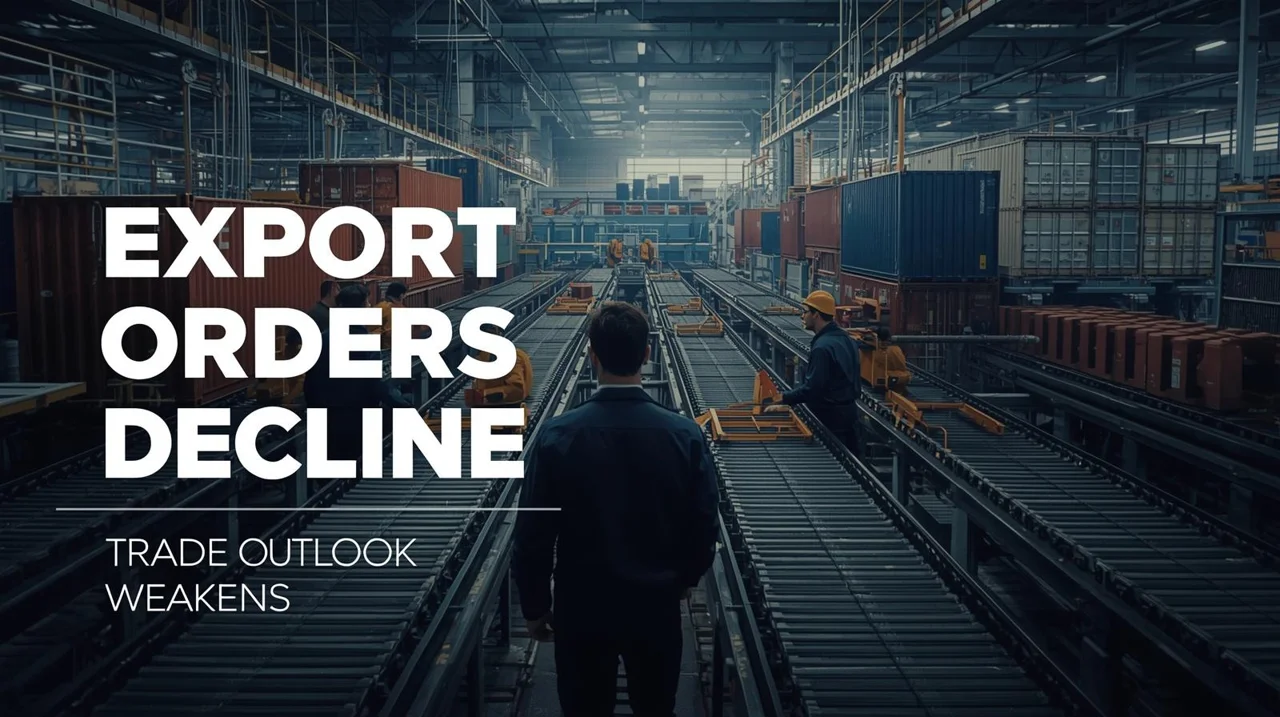
A noticeable slowdown is emerging in global trade as export orders decline across major manufacturing hubs. This trend is raising concerns about weakening demand, slower industrial activity, and broader economic impact.
Manufacturing hubs play a critical role in global supply chains, and any decline in export orders can affect not just industries but also employment and economic growth.
The key question is:
What is causing this decline, and how will it impact global trade and businesses?
The drop in export orders is driven by several interconnected factors.
One of the main reasons is weak global demand. As economies face uncertainty, businesses and consumers are reducing spending, leading to fewer international orders.
Another major factor is high inflation and rising costs. When production and transportation costs increase, goods become more expensive, reducing demand in international markets.
Geopolitical tensions are also playing a role. Trade restrictions, policy changes, and conflicts are affecting cross-border trade flows.
Additionally, currency fluctuations are making exports less competitive in some regions, further impacting order volumes.
Manufacturing hubs are directly affected by the decline in export orders.
Factories may reduce production levels due to lower demand, leading to slower industrial activity.
Some companies may delay expansion plans or cut costs to manage reduced revenue.
Smaller manufacturers, in particular, may face greater challenges due to limited financial flexibility.
This slowdown can also affect supply chains, as reduced production impacts suppliers and logistics providers.
The decline in export activity can have a direct impact on employment.
When production slows, companies may reduce hiring or limit new job opportunities.
In some cases, temporary layoffs or reduced working hours may occur, especially in export-dependent industries.
This can create uncertainty for workers and affect overall job market stability.
Export declines in key manufacturing hubs can influence the broader global economy.
Lower trade activity can slow economic growth, especially in countries that rely heavily on exports.
Reduced industrial output can also affect related sectors such as transportation, logistics, and raw material supply.
This creates a chain reaction, impacting multiple areas of the economy.
Companies are adopting different strategies to manage the slowdown.
Many are focusing on diversifying markets to reduce dependence on a single region.
Some businesses are exploring domestic demand as an alternative to declining exports.
Cost management and efficiency improvements are also being prioritized to maintain profitability.
In some cases, companies are investing in innovation to create more competitive products.
The current decline may lead to changes in global trade patterns.
Businesses may move toward more resilient and flexible supply chains to handle uncertainty.
Regional trade partnerships could become more important as companies look for stable markets.
Technology and automation may play a larger role in improving efficiency and reducing costs.
While short-term challenges exist, long-term adjustments could strengthen trade systems.
The decline in export orders across manufacturing hubs highlights growing challenges in global trade.
Weak demand, rising costs, and geopolitical factors are all contributing to a more uncertain outlook.
The key takeaway is clear:
Businesses and economies must adapt quickly to changing trade conditions to remain competitive and stable.
This article is for informational purposes only. Trade conditions and economic trends may change over time. Readers should stay updated with current developments for accurate insights.

Cori Close Signals Fatigue Amid Coaching Challenges Rise
UCLA coach Cori Close admits growing fatigue as NIL, transfer portal and revenue sharing reshape col
Dubai Airport Unveils Special Stamp for World Cup 2026
Dubai Airport introduces a special passport stamp to celebrate the 30th Dubai World Cup, set for Mar

Emaar Development Approves AED4bn Dividend at AGM Meet
Emaar Development reports record AED71.1bn sales in 2025, approves AED4bn dividend, and posts strong

Al Ain Hotel Upgrade Scheme Boosts Tourism Growth
Abu Dhabi launches hotel upgrade scheme in Al Ain, offering rebates to boost quality, attract touris

Taylor Swift Sweeps iHeartRadio Awards 2026 Big Wins
Taylor Swift wins seven iHeartRadio awards, shares inspiring message for artists, credits fans and E

Ajman University shines in QS Rankings by Subject 2026
Ajman University earns strong global QS 2026 rankings, with Dentistry leading in UAE and multiple su
Khalifa University Ranks 6th in Petroleum Engineering QS
Khalifa University secures 6th rank in Petroleum Engineering QS 2026, with strong gains across engin


Bank of Baroda Faces Abu Dhabi Legal Battle over NMC Collapse
Bank of Baroda’s involvement in Abu Dhabi litigation tied to the NMC Healthcare collapse raises repu

Top Museum Openings of 2026 Set to Transform Global Tourism
From Los Angeles to Abu Dhabi and Brussels, 2026 brings major museum launches—Lucas Museum, Guggenhe

UAE Tour Highlights UAE’s Strength in Hosting Global Sports Events
Abu Dhabi Sports Council says the successful UAE Tour reflects the UAE’s leading role in hosting maj

EU Seeks Clarity from US After Supreme Court IEEPA Ruling
European Commission urges full transparency from the US on steps after Supreme Court ruling, emphasi
SpaceX Launches 53 New Satellites for Expanding Starlink Network
SpaceX launches 53 Starlink satellites in two Falcon 9 missions, breaking reuse records and expandin

RTA Awards Contract for Phase II of Hessa Street Upgrade in Dubai
Phase II of Hessa Street Development to add bridges, tunnel, and upgraded intersections, doubling ca

UAE Gold Prices Today, Monday 16 February 2026: Dubai & Abu Dhabi Updated Rates
Gold prices in UAE on 16 Feb 2026 updated: 24K around AED 599.75/gm, 22K AED 555.25/gm, and 18K AED

Over 25 Ahmedabad Schools Receive Bomb Threat Email, Authorities Investigate
More than 25 schools in Ahmedabad evacuated after bomb threat emails mentioning Khalistan. Authoriti