Post by : Anis Karim
Parents today are bombarded with an excessive flow of information: school updates on multiple apps, health notifications from wearables, safety alerts, parenting advice from social media, and constant comparisons of what “good parenting” should look like.
Even routine decisions such as selecting a preschool or planning children’s meals come with layers of research, reviews, and expert opinions online. This leads to “decision fatigue,” where parents feel mentally drained long before the day ends.
Digital life isn’t a separate space anymore — it’s where children study, play, communicate and form early beliefs. Parents must monitor:
Screen-time
Content exposure
Online classes
Cyber-bullying risks
Social media behaviour
Online friendships
Gaming communities
Scams targeting minors
The pressure isn’t merely about keeping children safe online — it’s also the emotional stress of knowing one slip could carry long-term consequences.
Children’s toys, textbooks, apps and even learning tools are powered by AI. While they offer convenience, they also bring uncertainty:
What data is being collected?
How do algorithms shape a child’s thinking?
How much reliance on AI is too much?
Will children lose creativity or critical thinking?
Parents are expected to understand technology deeply, even when tech itself keeps evolving.
Modern parents are constantly exposed to curated images of perfection:
Kids with exceptional talents
Flawless morning routines
Ideal meals and healthy lunchboxes
Picture-perfect family outings
Impeccably organised homes
This creates an unrealistic benchmark that parents unknowingly hold themselves against — adding guilt, stress and self-doubt.
Beyond tasks and responsibilities, there is a deeper emotional burden:
Parents must handle their children’s emotions, soothe anxieties, mediate fights, and filter external stress — all while suppressing their own.
Predicting children’s needs, planning schedules, foreseeing problems, preparing solutions — this mental “preload” is exhausting.
The combination of news cycles, crime reports, cyber threats and health concerns has amplified parental anxiety in ways previous generations didn’t experience.
Children today think and communicate differently due to digital immersion. Parents must continually adapt just to stay connected.
Though roles are evolving, the imbalance remains strong.
Even in dual-income households, mothers often shoulder:
School reminders
Health monitoring
Meal planning
Emotional management
Household organisation
Social responsibilities
This is not always visible labour, yet it occupies overwhelming mental space.
Modern fathers are expected to be more involved than earlier generations. While many step up willingly, they struggle with:
Balancing work and family
Social expectation to “provide”
Emotional expectations from family members
Less societal permission to express stress
Both roles carry weight — just of different kinds.
Chronic stress leads to exhaustion, irritability and emotional distancing from family.
When mental load is imbalanced, resentment builds silently.
Parents’ stress often spills onto kids, creating a cycle of emotional tension.
Always-on parenting makes it difficult to focus fully on work or home.
Many parents feel they’ve lost their individuality in the process of managing everything.
Despite the challenges, parents are actively building healthier systems.
Couples are openly discussing:
Who handles school updates
Who monitors online activity
Who manages meals and schedules
How emotional responsibilities are shared
This clarity reduces resentment.
Families are adopting:
No-screen hours
Weekend social media detox
Tech-free dining time
Device-free bedrooms for children
This helps protect mental space.
Parents are using:
Deep-breathing routines
Reflection journaling
Mindful communication
Emotional-resilience building
These simple habits help restore balance.
Modern parents are increasingly using:
Meal-prep services
Digital organisers
Online counselling
Productivity tools
Home-help services
This helps lighten the mental burden.
Parents are forming:
Local parenting groups
Online safe communities
School-parent circles
Therapy support systems
Social connection eases emotional load.
Instead of constant supervision, parents are:
Educating children on safe digital choices
Creating trust-based rules
Encouraging open communication
Involving kids in online decision-making
This shifts some responsibility away from parents.
By the end of this decade, parenting will blend:
Tech literacy
Emotional intelligence
Digital control
Real-world connection
Mental wellness tools
Stronger co-parenting roles
The mental load may not vanish, but parents will learn smarter strategies to manage it.
Parenting in 2025 is a balancing act between love, responsibility, digital complexity and emotional endurance. While the mental load has grown heavier, awareness around it has also widened. Today’s parents are learning to express their needs, share invisible responsibilities, set boundaries with technology, and build resilient family structures.
The digital world is here to stay — but with intentional choices, families can thrive within it, instead of feeling overwhelmed by it.

Dubai Launches Commercial Driverless Taxis with Apollo Go
Dubai Taxi Company partners with Baidu’s Apollo Go to launch driverless taxis, advancing Dubai’s sma

Amelia Kerr Leads NZ to Record ODI Run Chase Against SA
Amelia Kerr’s unbeaten 179 powers New Zealand to record-breaking 348-run chase, beating South Africa

Sharjah Issues New Rules for Electric Vehicle Chargers
Sharjah’s Executive Council sets rules for EV charging stations, detailing installation, tariffs, sa
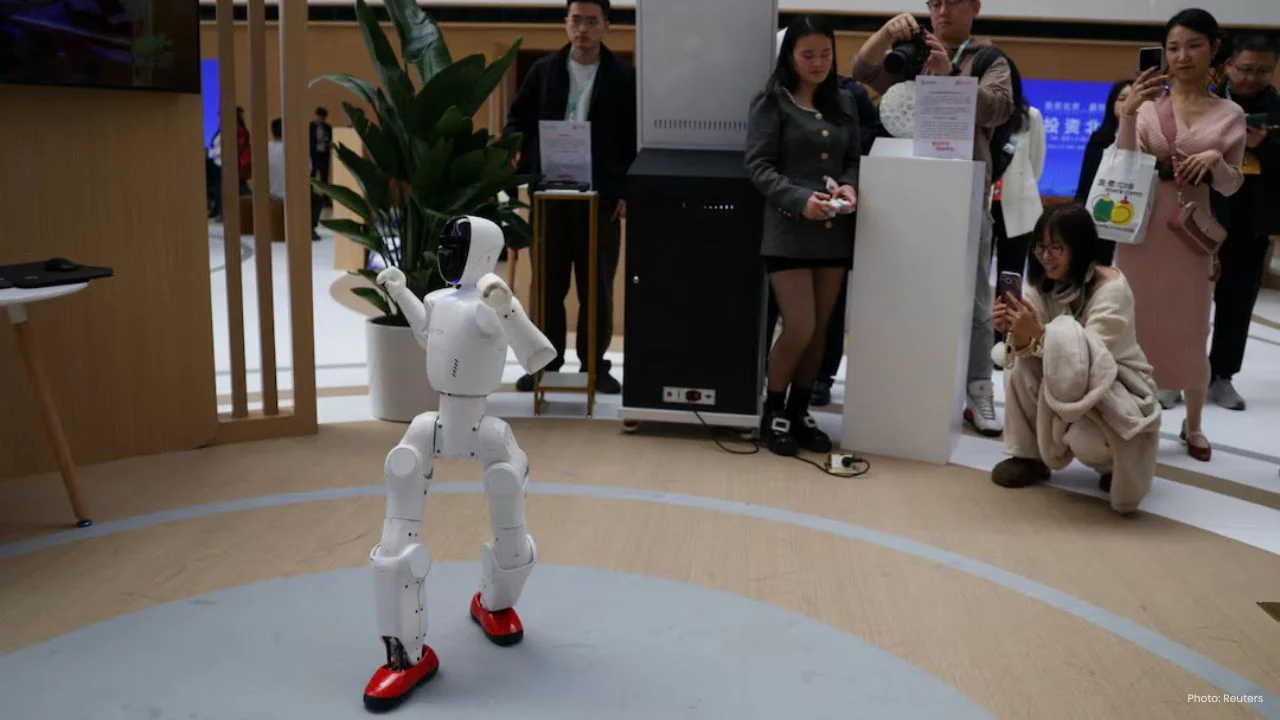
China VC Funding Hits Record on State-Driven Tech Push
China’s venture capital fundraising is set to hit a record in Q1 2026, led by state-backed investors

Russian Military Plane Crash in Crimea Kills 29 People
A Russian An-26 military plane crashed in Crimea, killing 29 onboard. Authorities suspect technical

IBPC Dubai AGM Strengthens India-UAE Economic Ties
IBPC Dubai AGM highlights growth, inclusivity, and upcoming conclaves, reinforcing India-UAE economi

EU Urges Protection of UNIFIL After Peacekeeper Deaths
EU nations demand protection of UNIFIL forces after deadly attacks, urging restraint and warning aga


Bank of Baroda Faces Abu Dhabi Legal Battle over NMC Collapse
Bank of Baroda’s involvement in Abu Dhabi litigation tied to the NMC Healthcare collapse raises repu

Top Museum Openings of 2026 Set to Transform Global Tourism
From Los Angeles to Abu Dhabi and Brussels, 2026 brings major museum launches—Lucas Museum, Guggenhe

UAE Tour Highlights UAE’s Strength in Hosting Global Sports Events
Abu Dhabi Sports Council says the successful UAE Tour reflects the UAE’s leading role in hosting maj
EU Seeks Clarity from US After Supreme Court IEEPA Ruling
European Commission urges full transparency from the US on steps after Supreme Court ruling, emphasi

SpaceX Launches 53 New Satellites for Expanding Starlink Network
SpaceX launches 53 Starlink satellites in two Falcon 9 missions, breaking reuse records and expandin

RTA Awards Contract for Phase II of Hessa Street Upgrade in Dubai
Phase II of Hessa Street Development to add bridges, tunnel, and upgraded intersections, doubling ca

UAE Gold Prices Today, Monday 16 February 2026: Dubai & Abu Dhabi Updated Rates
Gold prices in UAE on 16 Feb 2026 updated: 24K around AED 599.75/gm, 22K AED 555.25/gm, and 18K AED

Over 25 Ahmedabad Schools Receive Bomb Threat Email, Authorities Investigate
More than 25 schools in Ahmedabad evacuated after bomb threat emails mentioning Khalistan. Authoriti