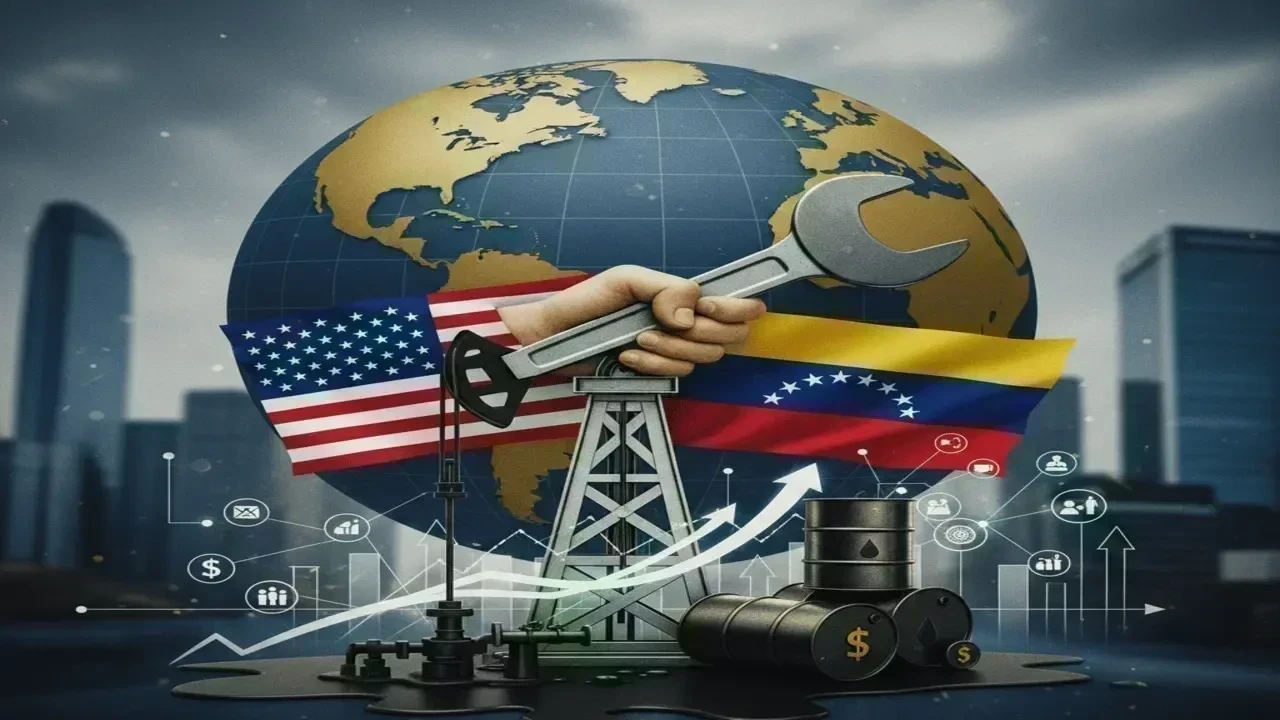
Post by : Sam Jeet Rahman
The phrase “US takes control of Venezuela’s oil sector” does not mean American troops or companies physically running oil fields overnight. Instead, it reflects a strategic shift in influence, licensing power, sanctions relief, financial oversight, and trade control that allows the United States to strongly shape how Venezuela’s oil is produced, sold, and priced in global markets. This influence-based control is reshaping energy flows, geopolitical alliances, and oil prices worldwide.
To understand the real impact, it is important to break down what this control actually means, why it is happening now, and how it affects global oil markets, emerging economies, and everyday fuel prices.
Venezuela holds the world’s largest proven oil reserves, even larger than Saudi Arabia. Most of this oil is heavy crude, which requires specialized refining but is extremely valuable when global supply tightens.
Despite this massive resource base, Venezuela’s oil output collapsed over the past decade due to:
Sanctions limiting exports and payments
Mismanagement of the state oil company PDVSA
Lack of foreign investment and technology
Infrastructure decay
At its peak, Venezuela produced over 3 million barrels per day. In recent years, production fell below 800,000 barrels per day, creating a gap in global supply that other producers struggled to fill.
The US does not own Venezuela’s oil fields. Control comes through economic levers, not direct ownership.
US sanctions historically restricted:
Who could buy Venezuelan oil
How payments could be processed
Which companies could operate in the sector
By selectively easing or tightening sanctions, the US decides how much Venezuelan oil enters the market and under what conditions.
US authorities grant licenses to specific companies, especially American and allied firms, allowing them to:
Extract oil
Export crude
Receive payments legally
This creates a system where oil flows only through approved channels, effectively placing trade control in US hands.
Most global oil trade depends on dollar-based systems. Even when Venezuela sells oil to third countries, US-controlled financial networks influence settlement, insurance, shipping, and compliance.
Any expansion of oil exports is tied to political commitments, elections, or reforms. This gives the US long-term leverage beyond short-term production gains.
This shift is driven by global energy instability, not generosity.
Conflicts involving Russia, the Middle East, and shipping routes have disrupted global oil supply. Sanctions on Russia removed millions of barrels from Western markets.
OPEC and OPEC+ members have repeatedly limited output to protect prices, leaving consuming nations vulnerable.
Fuel prices influence inflation, elections, and public sentiment. The US needs stable, controllable supply sources.
Venezuela offers a nearby, reserve-rich option that can be activated quickly under controlled conditions.
Even a partial recovery in Venezuelan output changes global balance.
An additional 300,000 to 500,000 barrels per day can:
Ease supply tightness
Reduce price volatility
Lower emergency reserve usage
Markets react not only to actual barrels but also to future supply expectations.
Venezuelan oil reduces reliance on:
Middle East shipping routes
Russian exports
Politically unstable transit zones
This improves energy security for the US and its allies.
Oil prices are driven by psychology as much as physics.
Even controlled Venezuelan output:
Caps extreme price spikes
Limits speculative rallies
Creates a price ceiling
Traders factor future supply into today’s prices.
Despite increased supply:
Production recovery is slow
Infrastructure limits remain
OPEC can adjust output to compensate
This means Venezuelan oil moderates prices rather than collapsing them.
Venezuela’s return reshapes power dynamics.
Some OPEC members rely heavily on higher prices. Increased supply:
Weakens coordinated price control
Forces internal negotiations
Increases competition
Saudi Arabia and Gulf producers may:
Adjust quotas
Delay expansions
Focus on long-term market share
Venezuela becomes a balancing tool rather than a dominant force.
Venezuela previously sold oil at discounts to bypass sanctions.
As exports move through licensed channels:
Discounts shrink
Contract terms tighten
Political leverage shifts
Countries that benefited from cheap oil may now pay closer to market rates.
Emerging economies face:
Tighter availability
Increased bidding
Less flexible payment structures
This can affect fuel subsidies and inflation in developing nations.
Multinational energy firms gain cautiously.
Companies operate under:
Strict compliance rules
Limited expansion rights
Constant political oversight
This reduces risk but limits profit upside.
Gradual upgrades:
Improve extraction efficiency
Reduce environmental damage
Increase long-term output potential
But recovery will take years, not months.
Consumers rarely feel immediate effects.
Price spikes become less severe during supply shocks.
More diversified supply reduces sudden shortages.
However, taxes, refining costs, and local policies still dominate retail fuel prices.
Control through influence carries risks.
Changes in leadership or compliance could:
Re-trigger sanctions
Halt exports suddenly
Shock markets
Years of neglect mean:
Equipment failures
Environmental risks
Production delays
Markets may overestimate recovery speed, leading to mispricing.
Venezuela’s oil is now a geopolitical instrument.
Every barrel from Venezuela reduces Western reliance on Russian energy.
Regional politics adjust as Venezuela:
Re-engages economically
Gains selective legitimacy
Loses unilateral control
Energy influence strengthens diplomatic leverage across trade and security discussions.
For Venezuela, this is not full recovery.
Increased revenue
Infrastructure investment
Partial economic stabilization
Limited sovereignty over oil policy
Dependence on external approval
Slow social recovery
Control brings cash, but not autonomy.
Markets are not betting on a Venezuelan oil boom. They are pricing:
Reduced extreme volatility
Better supply predictability
Fewer emergency disruptions
This explains why oil prices react moderately rather than dramatically.
The significance lies not in barrels alone, but in precedent. It shows how energy control in modern geopolitics is exercised through finance, regulation, and trade permissions rather than direct ownership.
This model may shape future interventions in other resource-rich nations.
The US shaping Venezuela’s oil sector marks a shift from isolation to managed integration. It strengthens supply security for consuming nations while limiting price shocks, but it also redefines sovereignty in global energy markets.
Oil is no longer just about who owns reserves. It is about who controls access, compliance, and flow.
This article is intended for informational and analytical purposes only. It does not constitute financial, investment, legal, or geopolitical advice. Energy markets and international policies are complex and subject to rapid change. Readers should consult authoritative sources or qualified experts before making decisions based on geopolitical or market developments.

Winter Skin Care: 10 Hydrating Drinks That Give Natural Glass Skin Glow
Learn how simple winter drinks keep your skin hydrated reduce dryness and support a natural glass sk

10 Songs That Carry the Same Grit and Realness as Banda Kaam Ka by Chaar Diwari
From underground hip hop to introspective rap here are ten songs that carry the same gritty realisti

PPG and JAFZA Launch Major Tree-Planting Drive for Sustainability
PPG teams up with JAFZA to plant 500 native trees, enhancing green spaces, biodiversity, and air qua

Dubai Welcomes Russia’s Largest Plastic Surgery Team
Russia’s largest plastic surgery team launches a new hub at Fayy Health, bringing world-class aesthe
The Art of Negotiation
Negotiation is more than deal making. It is a life skill that shapes business success leadership dec

Hong Kong Dragon Boat Challenge 2026 Makes Global Debut in Dubai
Dubai successfully hosted the world’s first Hong Kong dragon boat races of 2026, blending sport, cul

Ghanem Launches Regulated Fractional Property Ownership in KSA
Ghanem introduces regulated fractional real estate ownership in Saudi Arabia under REGA Sandbox, ena

Winter Skin Care: 10 Hydrating Drinks That Give Natural Glass Skin Glow
Learn how simple winter drinks keep your skin hydrated reduce dryness and support a natural glass sk

Why Drinking Soaked Chia Seeds Water With Lemon and Honey Before Breakfast Matters
Drinking soaked chia seeds water with lemon and honey before breakfast may support digestion hydrati

Morning Walk vs Evening Walk: Which Helps You Lose More Weight?
Morning or evening walk Learn how both help with weight loss and which walking time suits your body

What Really Happens When You Drink Lemon Turmeric Water Daily
Discover what happens to your body when you drink lemon turmeric water daily including digestion imm

DXB News Network Presents “Ctrl+Alt+Wim”, A Bold New Satirical Series Starring Global Entertainer Wim Hoste
DXB News Network premieres Ctrl+Alt+Wim, a bold new satirical micro‑series starring global entertain

High Heart Rate? 10 Common Causes and 10 Natural Ways to Lower It
Learn why heart rate rises and how to lower it naturally with simple habits healthy food calm routin

10 Simple Natural Remedies That Bring Out Your Skin’s Natural Glow
Discover simple natural remedies for glowing skin Easy daily habits clean care and healthy living ti

Mattel Revamps Masters of the Universe Action Figures for Upcoming Film
Mattel is set to revive Masters of the Universe action figures in sync with their new movie, ignitin