Author : Lamya M
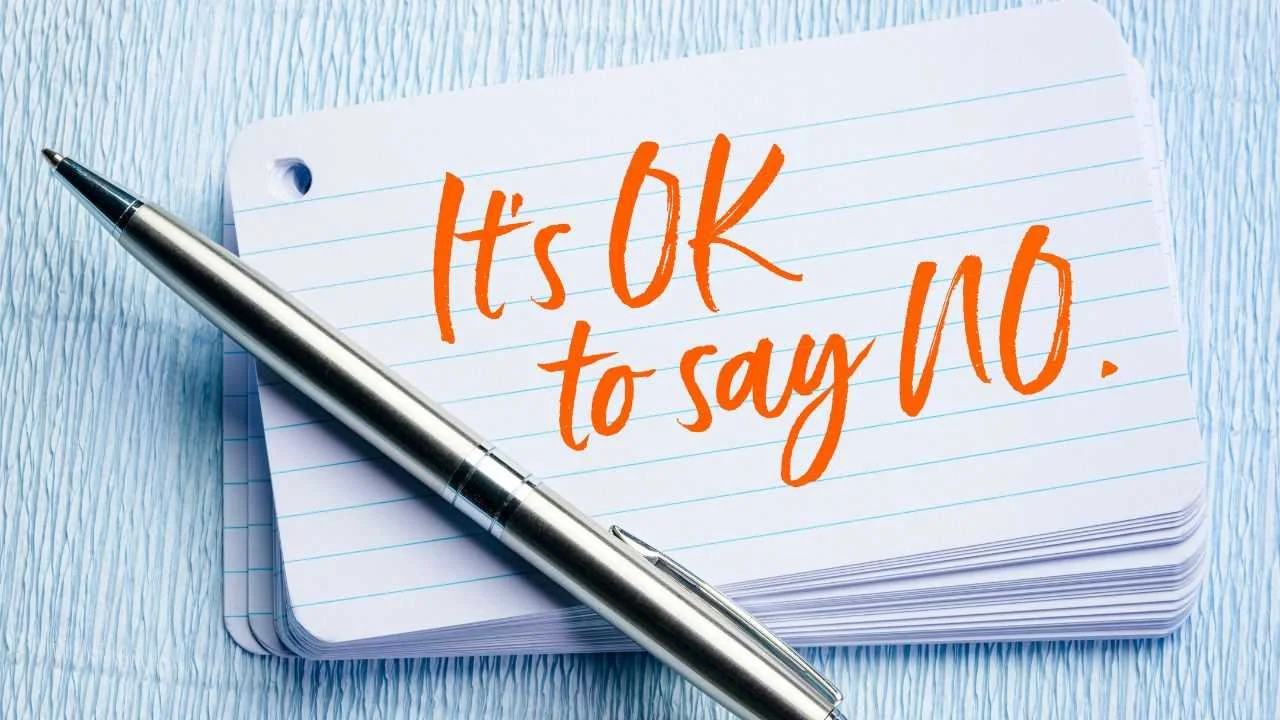
There is a small word in every language that carries enormous weight. It is simple, often just one syllable, yet it has the power to reshape relationships, protect your time, and redefine your sense of self. That word is “no”
And yet, for many people, it is one of the hardest words to say.
From an early age, we are conditioned to please. We are praised for being agreeable, helpful, flexible. We learn that saying yes brings approval, while saying no can invite disappointment, conflict, or even rejection. Over time, this conditioning becomes a habit—one that quietly erodes our boundaries and distances us from our own needs.
But saying no is not an act of selfishness. It is an act of clarity. It is a declaration that your time, energy, and emotional space have value. And learning how to say it—gracefully, firmly, and without guilt—is one of the most transformative skills a person can develop.
At its core, the struggle to say no is not about the word itself—it is about what we believe it represents.
For some, saying no feels like letting someone down. For others, it feels like risking conflict or losing connection. There is often a fear that boundaries will push people away, or that refusal will be misunderstood as rejection.
There is also the quiet pressure of expectation. Whether in work, family, or friendships, we carry invisible roles: the reliable one, the generous one, the one who always shows up. Saying no can feel like stepping out of character, like breaking an unspoken agreement.
But the truth is, constantly saying yes does not strengthen relationships—it strains them. It creates imbalance. It leads to exhaustion, resentment, and a sense of being overwhelmed. And eventually, the cost of always saying yes becomes far greater than the discomfort of saying no.
Every “yes” you give is a commitment. It takes time, energy, attention—resources that are limited, no matter how capable you are.
When you say yes to everything, you begin to stretch yourself thin. Your schedule fills up, your mind becomes cluttered, and your ability to be fully present diminishes. You may find yourself rushing through tasks, showing up half-engaged, or feeling quietly frustrated.
Worse, you may begin to lose sight of what truly matters to you.
Because every time you say yes to something that does not align with your priorities, you are indirectly saying no to something that does—your rest, your goals, your creativity, your peace. Saying no is not about rejection. It is about selection. It is how you choose what deserves a place in your life.
Read Also This: Why Saying No Is the Most Important Life Skill Today
One of the most powerful shifts you can make is to change how you think about saying no.
“No” is not a wall. It is a boundary.
It does not have to be harsh or abrupt. It does not have to be followed by guilt or long explanations. It can be calm, respectful, and clear. In fact, the most effective “no” is often the simplest one.
There is strength in clarity. When you communicate your limits honestly, you create space for healthier interactions. You teach others how to treat you—not through force, but through consistency.
And something surprising happens when you begin to say no more often: people respect you more, not less. Because boundaries signal self-awareness. They show that you understand your limits and honor them.
Saying no is not just a practical skill—it is an emotional one.
It requires awareness: knowing when something does not feel right, even if you cannot immediately explain why.
It requires honesty: acknowledging your limits without trying to disguise them or push past them.
And it requires courage: choosing to honor your needs even when it feels uncomfortable.
There is also a quiet compassion involved. Not just for others, but for yourself. Because every time you say no to something that drains you, you are saying yes to your well-being. You are choosing balance over burnout, intention over obligation.
One of the biggest obstacles to saying no is the guilt that often follows it. But guilt is not always a sign that you have done something wrong. Sometimes, it is simply a sign that you are doing something new.
Learning to say no without guilt begins with accepting a simple truth: you cannot meet every expectation.
Once you accept that, the pressure begins to ease. You do not need elaborate excuses. You do not need to justify every decision. A respectful and honest response is enough.
“I can’t commit to that right now.”
“I appreciate the offer, but I’ll have to pass.”
“That doesn’t work for me at the moment.”
These responses are not rude. They are clear. And clarity is kindness—because it avoids false promises and unspoken frustration.
Not every “no” has to be immediate.
In fact, one of the most effective strategies is to give yourself time before responding. Instead of automatically saying yes, allow yourself a pause.
“I’ll think about it.”
“Let me check my schedule and get back to you.”
This pause creates space between the request and your response. It allows you to evaluate whether the request aligns with your priorities, your energy, and your capacity. And often, that small moment of reflection is all you need to recognize that the answer should be no.
There is a common misconception that boundaries create distance. In reality, they create clarity.
When you are honest about what you can and cannot do, you reduce misunderstandings. You prevent resentment from building beneath the surface. You show up more authentically—because you are not overcommitting or pretending.
Healthy relationships are not built on constant agreement. They are built on mutual respect.
And respect includes recognizing that each person has limits.
When you honor your own boundaries, you also make it easier for others to honor theirs. You create a space where honesty is safe, where expectations are realistic, and where connection is not dependent on constant availability.
At its deepest level, saying no is an act of self-respect.
It is a way of acknowledging that your time is not infinite, that your energy is not limitless, and that your needs are not secondary. It is a quiet refusal to abandon yourself for the sake of convenience or approval. This does not mean becoming rigid or closed off. It means becoming intentional.
You begin to choose your commitments rather than react to them. You become more present in what you do say yes to, because those choices are aligned with your values.
And over time, this alignment creates a sense of balance that is both empowering and sustainable.
There is a kind of freedom that comes with learning to say no. It is not loud or dramatic. It is subtle, steady, and deeply grounding.
It shows up as a lighter schedule, a clearer mind, a stronger sense of direction. It allows you to invest your energy where it truly matters—into work that fulfills you, relationships that support you, and moments that bring you peace.
You begin to realize that you do not need to do everything to be enough. You do not need to say yes to be valued. And perhaps most importantly, you learn that every no you say with intention creates space for a more meaningful yes.
The art of saying no is not about rejection—it is about refinement.
It is about shaping your life with intention rather than obligation. It is about protecting what matters without apology. It is about recognizing that your voice, your time, and your energy deserve to be honored.
And like any art, it takes practice. At first, it may feel uncomfortable. You may hesitate, overthink, or second-guess yourself. But with time, it becomes easier. More natural. More aligned with who you are. Until one day, saying no no longer feels like a loss.
It feels like clarity. It feels like strength. It feels like coming home to yourself.

Canada Offers $120 Million in Humanitarian Aid as Sudan Conflict Surges
In light of the escalating war in Sudan, Canada pledges $120 million to aid humanitarian efforts, ad

Kazakhstan's Crackdown on Activists Following Xinjiang Protests
Kazakhstan sentences 19 activists for protesting China's Xinjiang policies, stirring global concerns

India Engages in Women Quota Bill Debate Amid Boundaries Controversy
The 33% women quota bill in India is sparking debate and political tension over linked seat redistri

Vancouver Mayor Ken Sim Champions MLB Expansion for the City
Mayor Ken Sim reveals plans for Vancouver to secure an MLB team bid, citing rising interest in baseb

Escalating Wage Protests in Noida Lead to 350 Arrests
Protests over wages in Noida intensify, resulting in 350 arrests as workers demand better pay and co
56 Years of Earth Day: A Call to Action on Climate Threats
As Earth Day turns 56, the urgent need for sustainable actions against climate change is more vital

UAE Denounces Turkey School Shooting, Offers Condolences
UAE condemns Turkey school shooting that killed 9, injured 13. Expresses condolences, rejects violen


7 Daily Habits to Burn Belly Fat Naturally
Discover 7 simple daily habits to burn belly fat naturally without extreme dieting. Easy, effective
Power of Compounding: How $5,000 Can Grow Into $120,000
Discover how compounding turns $5,000 into $120,000 over time. Learn long-term investing strategies

When to Test Blood Sugar: Morning vs After Breakfast Explained
Should you check blood sugar fasting or after meals? Learn the best time to test glucose levels and

WhatsApp Down Today? Users Report Strange Issue Worldwide
WhatsApp users report message delays and strange issues worldwide. Find out what happened, why it oc

Is Your Phone Spying on You? 6 Android Settings to Turn Off Now
Worried your phone is spying on you? Learn 6 Android settings to turn off now to protect your privac

7 Protein-Rich Indian Foods You Should Add to Your Daily Diet
Discover 7 protein-rich Indian foods to boost your daily protein intake naturally without supplement

Is It Safe to Keep Laptop Plugged In All the Time? Battery Truth Explained
Is it safe to keep your laptop plugged in all day? Learn the truth about battery health, charging ha

Actual Cost of Living in Dubai for a Family : Rent, School Fees & Monthly Expenses
Discover the real cost of living in Dubai for a small family in 2026, including rent, school fees, g