Post by : Kanchan Chandel
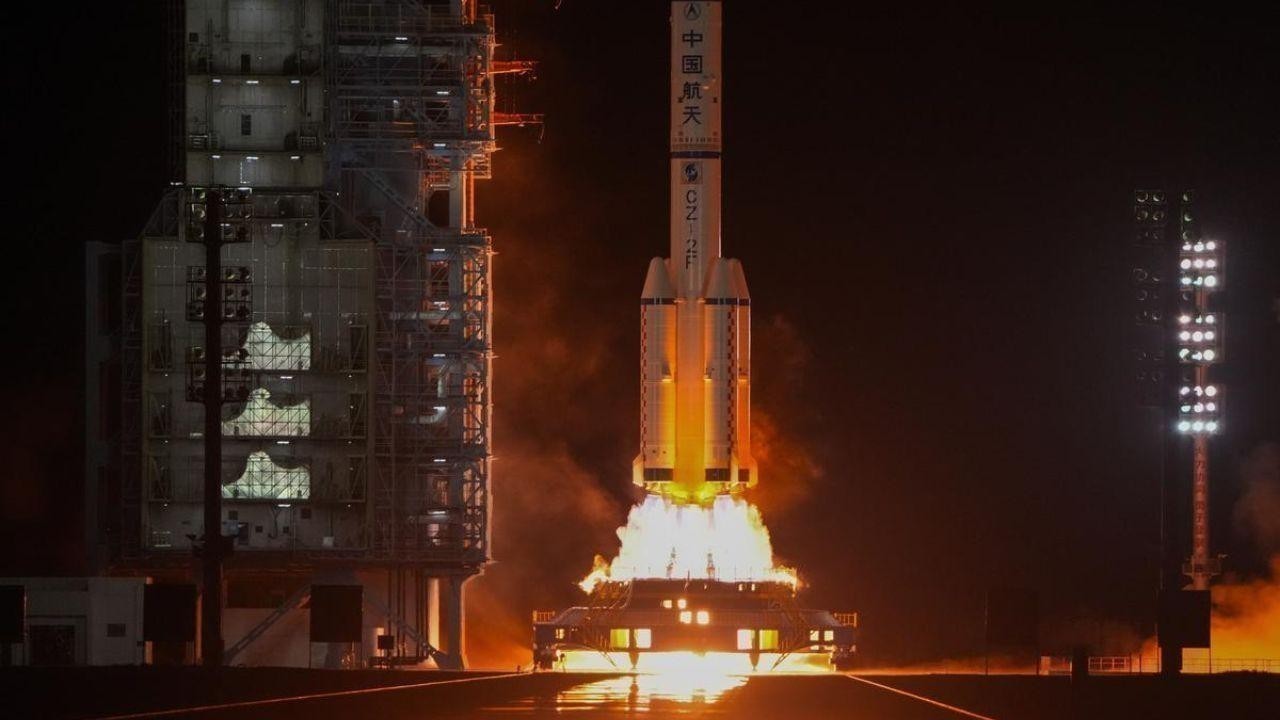
Photo-AP
China successfully launched a three-member crew to its orbiting space station on Thursday, marking another milestone in its ambitious space exploration program. The launch, conducted from the Jiuquan Satellite Launch Center in northwestern China, saw the Shenzhou-18 spacecraft lifting off atop a Long March 2-F rocket at 8:59 p.m. local time.
The crew, consisting of Commander Ye Guangfu and fighter pilots Li Cong and Li Guangsu, embarked on their mission to relieve the Shenzhou-17 team currently stationed at China's Tiangong space station. Ahead of their departure, the China Manned Space Agency (CMSA) held a ceremonial send-off, complete with patriotic fervor and flag-waving children.
Commander Ye Guangfu, a veteran astronaut who participated in the Shenzhou-13 mission in 2021, leads the team, supported by rookies Li Cong, 34, and Li Guangsu, 36, both experienced fighter pilots. The crew's primary objectives include scientific research, installation of space debris protection equipment, payload experiments, and science education initiatives during their anticipated six-month stay aboard the space station.
Stay informed with the latest news. Follow DXB News Network on WhatsApp Channel
China's pursuit of its own space station arose after being excluded from the International Space Station, primarily due to concerns over military involvement. This year, China plans two cargo spacecraft missions and two manned spaceflight missions to its station.
Looking ahead, Lin Xiqiang, deputy director of CMSA, mentioned China's aspirations to open its space station to foreign astronauts and space tourists in the future. Additionally, China has ambitious plans for space exploration, including sample return missions from Mars, lunar probe missions, and the goal of landing astronauts on the moon by 2030.
Since its first crewed space mission in 2003, China has made significant strides in space exploration, rivaling established space powers like the United States. While the U.S. maintains an edge in certain areas, China's recent achievements, such as lunar sample return missions and exploration of the moon's far side, highlight its growing capabilities in space exploration.
With renewed commitments to crewed missions, including plans for lunar surface exploration by 2025, the space race between China and the United States continues to evolve, driven by advancements in technology and collaboration with private sector entities like SpaceX and Blue Origin.